港股即時

Economic Calendar

Monday, October 3, 2016

引: U.S. Imports Record Amount Of Gold From Switzerland In July

U.S. Imports Record Amount Of Gold From Switzerland In July

Filed in Precious Metals by  on September 23, 2016

It seems as if the tide has changed as the U.S. imported a record amount of gold from Switzerland in July.  Normally, the flow of gold from the United States has been heading toward Switzerland.  For example, when the U.S. exported a record 691 metric tons (mt) of gold in 2013, Switzerland received 284 mt, which accounted for 41% of the total.  Compare that to the paltry 3 metric tons of gold imported from Switzerland that very same year.
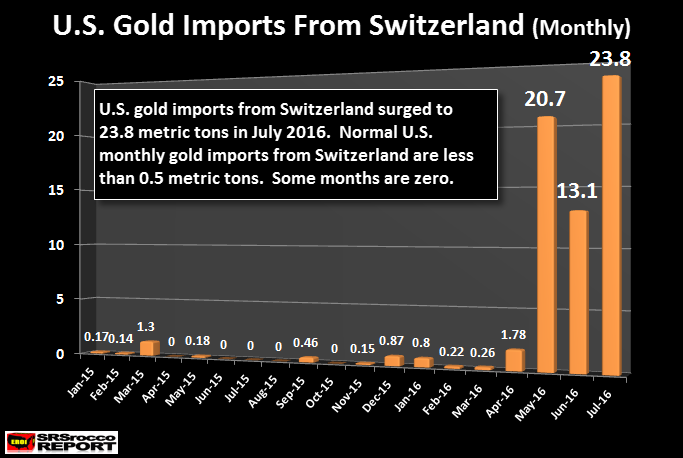
However, something has changed in the market dynamics as the U.S. imported a record 23.8 mt of gold from Switzerland in July:
us-gold-imports-from-swtizerland-jul-2016-monthly
As I stated in my previous article, WHAT’S GOING ON?? Record Swiss Gold Flow Into The United States: the Swiss exported 20.7 mt of gold in May 2016, up considerably from its monthly average 0.4 mt.  Even though gold imports from Switzerland declined the next month to only 13.1 mt in June, they were still much higher than their monthly average going back until Jan. 2015.
But, as we can see… U.S. gold imports from Switzerland jumped 82% in July to 23.8 mt compared to June.  There has been speculation in the precious metals community as to why the Swiss are now exported gold to the United States.  While many theories seem plausible, the one that makes the most sense is that investors in Europe who have their gold stored in Switzerland are moving it to the United States to protect it from the implications of negative interest rates.
Furthermore, after the Brexit vote for the U.K. to leave the European Union (In June), it has also put a lot of stress on investors holding assets within the E.U. countries.  For whatever reason, gold bullion is now flowing into the United States from Switzerland in record volume for the first time in many years.
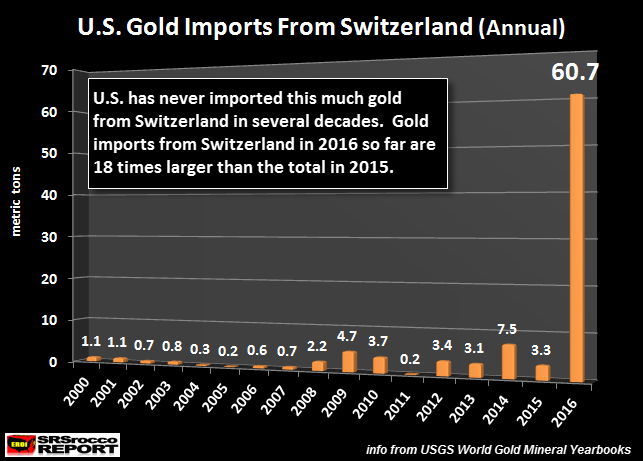
This next chart shows the annual imports of gold from Switzerland going back until 2000:
us-gold-imports-from-switzerland-jul-2016-annuallynew
As we can see, Switzerland’s gold exports to the U.S. are already 60.7 mt in 2016, up more than 18 times the volume in 2015.  Again, for whatever reason, Swiss gold is heading into the United States in record volume.
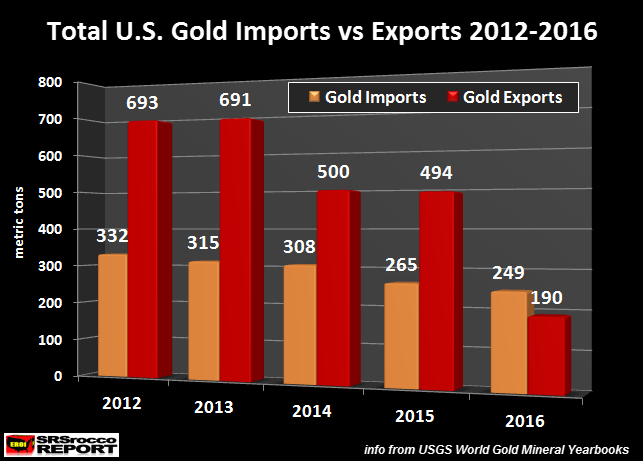
In addition, this is the first year the U.S. has imported more gold than it has exported in several years:
us-total-gold-imports-vs-exports-2012-2106
In 2012, the United States exported a record 693 mt of gold, while imports were only 332 mt.  Even though the volume of U.S. gold exports declined in 2014 and 2015, they were still much higher than imports (62% & 86% respectively).
However, this has changed in the first seven months of 2016, as the U.S. has imported 249 mt of gold versus exports of only 190 mt.  The majority of the increase of U.S. gold imports came from Switzerland.  Of the 249 mt of U.S. gold imports Jan-July 2016, Switzerland accounted for 60.7 mt, compared to only 3 mt in 2015.
With the upcoming Chinese Yuan into the IMF SDR (Special Drawing Rights) on Oct 1st, the situation for the U.S. Dollar going forward will come under increased stress as global trade moves more into Chinese Yuan currency.  This will negatively impact the U.S. Treasury holdings by foreigners as they move into owning more Chinese Yuan for trade.
The days of the U.S. Dollar Reserve currency status is coming to an end.  It is no surprise that Russia and China continue to add a great deal of gold to their official holdings.
Lastly, I will be publishing a very important article on the precious metals next week.  It will provide analysis on the top four precious metals (Gold, Platinum, Palladium and Silver) that most investors have not seen before.  It will be out either Monday or Tuesday next week.


Source:
https://srsroccoreport.com/u-s-imports-record-amount-of-gold-from-switzerland-in-july/

引 : 實體黃金有詭!美今年來對瑞士的進口較去年暴增18倍

實體黃金有詭!美今年來對瑞士的進口較去年暴增18倍


MoneyDJ新聞 2016-09-26 09:28:18 記者 郭妍希 報導

追蹤黃金報價的期貨、ETF滿天飛,但這些合約承諾的黃金、卻是現實世界總產量的100倍(甚至更多),先前也傳出有期貨、ETF投資人要求以實體黃金結算,卻換不到黃金的消息。以此來看,過去數年向來以出口黃金為主的美國,7月跟瑞士進口的實體黃金卻突然暴增8成、單月進口量登史上高,年初迄今的進口量更是去年一整年的18倍,這樣的消息相當值得關注。
SRSrocco Report 23日報導,統計顯示,美國7月從瑞士進口的黃金總量飆升至23.8噸、較6月的13.1噸高出82%之多,而5月的進口量也多達20.7噸,這三個月的進口量都遠多於2015年1月以來的平均月進口量(0.4噸)。(圖表見此)
不僅如此,美國今(2016)年迄今從瑞士進口的黃金總量已經高達60.7噸,是去年一整年(3.3公噸)的18倍之多!

如此奇怪的現象也引發諸多揣測。有人認為,把黃金儲藏在瑞士的歐洲投資人,為了避免負利率的衝擊,因此決定把黃金移往美國。另外則有人猜測,英國6月舉行公投決定脫歐後,在歐盟國家持有資產的投資人面臨了龐大壓力。無論是哪種原因,實體黃金的流向的確已開始逆轉,美國從瑞士進口的黃金總量大幅跳增,是多年以來首見。
這是相當不尋常的現象。正常來講,實體黃金通常都是從美國流向瑞士,舉例來說,美國2013年就出口了691噸的黃金、創歷史新高,瑞士當年則收到284噸。
為何要觀察瑞士相對於美國的黃金進出口數據?2011年暢銷財經書《下一波全球貨幣大戰》(Currency Wars: The Making of the Next Global Crisis)作者James Rickards 9月初在The Daily Reckoning網站撰文解釋,各國實體黃金的進出口資料,以瑞士最為透明,而瑞士進口黃金主要是為了精煉,之後會出口到世界各地,同時瑞士既無金礦、民眾也無囤金習慣,因此相當適合用來觀察全球實體黃金的流動方向。
根據Rickards當時的說法,紐約商品期貨交易所(COMEX)的黃金期貨以及黃金ETF都是所謂的紙黃金,資料顯示這些紙上合約承諾的黃金總量,大概是實體黃金的100倍(甚至更多)。只要紙上黃金的投資人要求以實體黃金結算,他們就會驚覺,世界上根本就沒有這麼多實體黃金可以流通,屆時勢必會引爆黃金爭奪戰,金價也會飆高好幾千美元,金礦類股更將狂漲十倍以上,而期貨交易所也會被迫關閉。
黃金恐慌買盤何時引爆?Rickards認為,一切都要觀察實體黃金的供需動向。根據Rickards觀察,瑞士過去四個月一直是黃金的淨出口國,這代表市場需求強勁,但供給卻頗為緊縮。若瑞士的黃金持續呈現淨出口,那就代表需求過多、供給減少,金價也將跟著走強。數據並顯示,瑞士精煉過的黃金主要出口到五處,分別是中國大陸、香港、印度、英國與美國,共佔總出口量的91%。
Rickards警告,他所得到的第一手消息顯示,瑞士的黃金供給量已經相當吃緊,假如短缺繼續惡化,那麼金價肯定會跳高,屆時ETF需求更將助長金價火焰,而整個紙黃金體制遲早要崩塌。(詳細新聞見此)


原文:
http://www.moneydj.com/funddj/ya/yp050000.djhtm?a=4B3B3CEF-CD9C-427F-83C9-1D82581EBC6F

Sunday, October 2, 2016

英國首相Teresa May 落實英國脫歐時間表為明天三月

"PM May says to trigger EU divorce by end of March" - http://uk.reuters.com/article/idUKKCN12208E

World News 世界新聞

World News 世界新聞

俄羅斯新聞 Russia News:

http://primpress.ru/

英文新聞資訊 English News:


聯合國新聞 - United Nations News (聯合國 - United Nations)

路透社 - Reuters (英國 - UK)

BBC News (英國 - UK)

泰晤士報 Times & Sunday Times (英國 - UK)

每日電訊報 Daily Telegraph (英國 - UK)

ABC News (美國 - USA)

CNN News (美國 - USA)

今日美國 USA Today (美國 -USA)

華爾街日報 Wall Street Journal (美國 - USA)

華盛頓郵報 Washingtonpost (美國 - USA)

紐約每日新聞 New York Daily News (美國 -USA)

休士頓紀事報 Houston Chronicle (美國 -USA)

洛杉磯時報 LA times (美國 -USA)

波士頓日報 Boston.com  (美國 -USA)

CBS News (美國 - USA)

芝加哥太陽時報 (美國 - USA)

彭博社 Bloomberg (美國 -USA)

法新社 AFP (法國- France)

國際紐約時報 International New York Times (法國 -France)

俄通社塔斯社 Tass (俄羅斯 - Russsia)

澳州人報 The Australian (澳州 -Australia)

悉尼先驅晨報 Sydney morning herald (澳州 -Australia)

國士報 Haaretz (以色列 - Israel)

以色列  The Jerusalem Post (以色列 - Israel)

加拿大Post Media (加拿大 - Canada)

日本時報 Japan times (日本 - Japan)

Asia Nikkei (日本 - Japan)


中文新聞資訊 Chinese News:


共同網 Kyodo News (日本 -Japan)

朝日新聞 Asachi News (日本 - Japan)

華爾街見聞 (中國 - China)

Friday, September 30, 2016

引:Ten People Who Will Be Key in Deciding Deutsche Bank’s Future

Ten People Who Will Be Key in Deciding Deutsche Bank’s Future
September 30, 2016 — 6:01 AM HKT
Could the Euro Benefit from Pressurized Banks?
Players include Merkel, Achleitner, Draghi and Schaeuble
DBK boss Cryan: Raising capital is “currently not an issue”
Pressure on Deutsche Bank AG has increased since the lender revealed two weeks ago the U.S. Justice Department is asking for $14 billion to settle a probe tied to residential mortgage-backed securities the bank traded before the 2008 financial crisis.
Amid concerns about the bank’s finances, about 10 hedge funds that use its prime brokerage service moved part of their listed derivatives holdings to other firms this week, according to an internal bank document Bloomberg News has seen
Germany’s biggest lender is firing workers, dumping unprofitable clients and exiting businesses. Still, doubts remain about whether it has the resources to cope with multiple legal probes without raising capital -- though Deutsche Bank and the German government have said the company can stand on its own.
As the saga unfolds, here are 10 people who will be instrumental in deciding Deutsche Bank’s fate:
Bill Baer

Photographer: Andrew Harrer/Bloomberg
BILL BAER. The U.S. Justice Department’s No. 3 official is calling the shots in the Deutsche Bank talks. An antitrust lawyer by training, Baer was previously chief of the division that oversees reviews of mergers and acquisitions, where he gained a reputation for aggressively opposing deals the department deemed anticompetitive. Baer last year secured guilty pleas and $6 billion in penalties from a group of lenders over currency-market rigging. While he hasn’t directly commented on Deutsche Bank, Baer says banks are to blame for slow progress in mortgage settlement talks. “Each prolonged the period in which a cloud of uncertainty hung over the institution,” Baer said in a speech this week. “And each paid a lot more than it would have if it had cooperated early on.”
JOHN CRYAN. Deutsche Bank’s chief executive officer is trying to shore up capital buffers and profitability while selling assets, cutting jobs, and suspending dividends. Cryan faces headwinds from volatile markets, negative interest rates and tougher regulatory scrutiny. Cryan this week told Germany’s Bild newspaper that raising capital is “currently not an issue” and said he has no interest in government support.
 
Paul Achleitner

Photographer: Martin Leissl/Bloomberg
PAUL ACHLEITNER. The chairman of Deutsche Bank’s supervisory board is known for his deep contacts across the industry. He chose Cryan to pick up the pieces after previous leaders failed to root out the misconduct that had drawn the wrath of prosecutors from New York to London. But Achleitner’s star has begun to fade as investors grow impatient with a plunging share price and continuing turmoil. The chinks became visible in April, when he became embroiled in a boardroom feud over probes into alleged wrongdoing.
ANGELA MERKEL. The German chancellor would make the final decision on any state aid for Deutsche Bank. Having steered Germany through the 2008-2009 financial crisis, she’s a veteran of bank rescues. That experience has also given her an acute awareness of the political pitfalls of assisting the financial sector, especially as Germany prepares for national elections next year. Cautious by nature, this week she said she hopes the bank “can develop well.”
Wolfgang Schaeuble

Photographer: Krisztian Bocsi/Bloomberg
WOLFGANG SCHAEUBLE. The German finance minister, the country’s elder statesman and Merkel’s chief lieutenant on financial matters, would craft and execute any government rescue of Deutsche Bank. In February he said he has “no concerns about Deutsche Bank.” These days, he’s avoiding public comment -- though on Wednesday his ministry denied a report in Die Zeit that the government was working on a rescue plan.
MARIO DRAGHI. The European Central Bank president would likely become involved before a lender is liquidated or broken up. While decisions of the ECB’s supervisory arm are usually rubber-stamped by the Governing Council, in this case policy makers may want to weigh the gravity of a bank’s woes against the potentially crippling effects that dissolving a lender would have on the euro and Europe’s economic recovery. Draghi has said he doesn’t “share the view” that low interest rates -- the root of many of Deutsche Bank’s problems -- pose systemic risk.
DANIELE NOUY. The chair of the European Central Bank’s Supervisory Board is in charge of scrutinizing Deutsche Bank’s activities and balance sheet. She will have the final say in setting the bank’s capital requirements for 2017, and would make the initial call on whether a struggling bank is no longer viable. She has suggested that Europe’s banking sector is ripe for consolidation.
Elke Koenig

Photographer: Ralph Orlowski/Bloomberg
ELKE KOENIG. The chairwoman of the Single Resolution Board in Brussels would manage any eventual liquidation or breakup of Deutsche Bank. Koenig is the first chief of the agency, established in December 2014 as a clearinghouse for plans to mitigate the negative impact of any major bank failure. As the former chief of Germany’s banking supervisor, she’s well acquainted with Deutsche Bank’s difficulties.
FELIX HUFELD. The president of BaFin, Germany’s financial markets watchdog, works with his Bundesbank and ECB colleagues to monitor banks. While Germany’s representatives on the ECB’s Supervisory Board include Bafin and the Bundesbank, only Hufeld has voting rights. He hasn’t commented on Deutsche Bank specifically, but Hufeld has said low interest rates are devastating bank profits and that institutions must cut costs to survive. “Things can’t continue as they have,” he said at a conference in Berlin on Wednesday.
MARGRETHE VESTAGER. The former Danish finance minister is now in charge of competition and state aid for the European Union’s executive arm. She would need to scrutinize any government rescue plan to check that it doesn’t fall afoul of the EU’s strict limits on giving companies public support.


Fines, Withdrawals, Job Cuts. It Was an Ugly Day for Global Banks
September 30, 2016 — 5:50 AM HKT

What Do Deutsche Bank Clients, Investors Fear?
Funds pull cash from Deutsche Bank, Commerzbank to slash jobs
Wells Fargo’s Stumpf grilled by House committee over accounts
Even before the opening bell in New York, Thursday looked like a grim day for some of the giants of global banking.
But few expected the barrage of bad news that soon hit on both sides of the Atlantic -- a rat-a-tat-tat of job cuts, scandal and financial worry that sent bank shares tumbling and left many investors wondering just where or when the pain would end.
It began in Germany, where long-struggling Commerzbank AG unveiled yet another plan to regain its footing, this time by cutting one in five of its employees. In Washington, came still more blistering attacks on John Stumpf, whose grip atop embattled Wells Fargo & Co., the largest U.S. mortgage lender, remains tenuous amid the uproar over a scandal involving unauthorized accounts.
And then, back in Germany, came the bombshell: revelations that some hedge funds were moving to reduce their financial exposure to Deutsche Bank, now the biggest worry in global finance. Before Stumpf left the U.S. House chambers after more than four hours of grilling, news broke his bank would be hit with more penalties after improperly repossessing cars owned by U.S. soldiers.
“While each has unique challenges, the overwhelming thing that has happened to the banks is they’re forgetting their purpose, while complexity is increasing opportunity for errors,” said Jon Lukomnik, executive director of the Investor Responsibility Research Center Institute in New York.
Eight years after the financial crisis, the global banking industry is groping for a way forward. Global regulators have sought to make banks look more like boring utilities, but that road has proven steep. Emboldened by an international populist groundswell, they continue to dole out fines and penalties, and firms are scrambling for ways to make money as trading volumes decline and capital requirements become more stringent. 
The 38-company Bloomberg Europe Banks and Financial Services Index has tumbled 24 percent this year, while the KBW Bank Index of 24 U.S. lenders has slid 4.6 percent, led by Wells Fargo’s 18 percent decline.
In the past 10 days, Stumpf has agreed to forgo $41 million in compensation, and an adviser to Turkish President Recep Tayyip Erdogan glibly suggested on Twitter that Turkey buy Deutsche Bank as its market value fell by more than half this year. The German lender is now barely worth more than the $14 billion settlement the U.S. Department of Justice would like to extract in a long-running investigation of the bank’s mortgage securities business.
Commerzbank Chief Executive Officer Martin Zielke announced plans Thursday to eliminate 9,600 jobs, leaving it no bigger than it was before its 2008 acquisition of Dresdner Bank. The Frankfurt-based bank has lost about 39 percent of its market value this year.
“Germany is still overbanked, and it’s tough to have Germany as your home base when you want to compete with French, Spanish or American peers that operate in less fragmented home markets,” said Klaus Fleischer, a professor of finance at the University of Applied Sciences in Munich.
Wells Fargo agreed to pay more than $24 million to the Justice Department and the Office of the Comptroller of the Currency to settle allegations that it improperly repossessed cars owned by members of the military.
“I don’t personally see how you survive,” Representative Denny Heck, a Washington Democrat, told Stumpf Thursday as the 63-year-old CEO testified before the House Financial Services Committee.
Lawmakers called for Stumpf to be fired, for Wells Fargo’s board to be replaced and for the bank to be broken up.
“Your problem is coming,” Representative Mike Capuano, a Massachusetts Democrat, told Stumpf at the hearings. “You think today is tough? It’s coming. When the prosecutors get ahold of you, you’re going to have a lot of fun."
As the hearing was under way, news broke that some of Deutsche Bank’s clients were said to be reducing their collateral on trades, sending its New York-listed shares down as much as 9.1 percent. Earlier this week, CEO John Cryan was forced to shoot down speculation the bank needs more capital and may require a bailout, as its shares touch record lows and a U.S. litigation settlement looms.
“Our trading clients are amongst the world’s most sophisticated investors,” Michael Golden, a spokesman for Deutsche Bank, said in an e-mailed statement. “We are confident that the vast majority of them have a full understanding of our stable financial position, the current macroeconomic environment, the litigation process in the U.S. and the progress we are making with our strategy.”
寫: Contingent Convertible Bonds (CoCo Bond)

最近德銀財務上似乎頗為嚴峻,又要炒人重組架構甚麼的,而導致其墮入這嚴峻狀態的其中一大原因就是 CoCo Bond,所以花一些時間去理解一下CoCo Bond,順便記錄下來。

CoCo Bond是甚麼?

以下為 Investopedia 的解釋。

Contingent convertibles (CoCos) are similar to traditional convertible bonds in that there is a strike price, which is the cost of the stock when the bond converts into stock. What differs is that there is another threshold in addition to the strike price, which triggers the conversion when certain capital conditions are met. 

Read more: Contingent Convertibles - CoCos Definition | Investopedia http://www.investopedia.com/terms/c/contingentconvertible.asp#ixzz4Lik5bES9


簡單來說就是可換股的債,而這種可換股的債是在一些「特定條件」下,會觸發到債主必須或可能要把手上的CoCo債轉換成該公司的股份。

而一般銀行發的的CoCo Bond ,其觸發的「特定條件」,就是銀行本身的資本充足率(Capital Ratio)若低於某水平後就會觸發債變股情況。

銀行發CoCo Bond的好處,從Econ記者的blog裡有簡單易明的說明。


「扼要來說,就是政府不用在銀行出現資不抵債的情況時bail-out銀行,所謂Bail-out亦即是大量注資給銀行。Bail-out需能救得銀行不致缺資金而倒閉,但卻不能根治原本導致資不抵債而流血的源頭,而且更導致銀行由一個爛蘋果變成一個更大的爛蘋果。 CoCo Bond 同樣不能根治資不抵債流血的源頭,但卻能發揮Bail-in 功能,因為由債變股,能在帳目上減少債又以變成股的方式增大資本,變相改變了Capital Ratio 資不抵債的帳目狀況。 」
-- 出自Econ 記者的  下一個金融海嘯的源頭-Coco Bonds ,
明明有此好處,為甚麼CoCo Bond又變成了債房毒藥?

這是因為不同銀行的CoCo Bond,其「特定條件」除了資本充足率的確觸發點外,亦有更多形形式式的觸發點,而其中一些觸發條款不但使債變股,更會令債主變一無所有。
Econ記者的解釋簡單易明。
當市場上有過多的Coco Bonds時,好易引發Death Spiral(死亡循環),當大跌市出現將觸發Coco Bonds債變股,但這樣下來投資者就要開始承受更大的損失(本來持債權,銀行一日違約,理論上仍無大損失,但變成股權則會馬上錄得損失)。而如果投資者又同時大量沽售這批股份,供應大增勢會令跌幅加劇,更甚至可觸發對銀行的信心危機。」

而更嚴重的問題,就是市場上很多投資者根本就係唔了解CoCo Bond本質,唔知自己買乜。而銀行打工既人本身亦無動力要去教投資者其內容風險。

結果就是 「一群無知」配合「一群唔想你知」,而導致資本不足的源頭又從無解決。

Thursday, September 29, 2016

引:保加利亞換馬 聯合國秘書長角逐形勢大變

引:保加利亞換馬 聯合國秘書長角逐形勢大變

聯合國秘書長潘基文將在今年年底卸任,但挑選下任秘書長的形勢在只餘僅3個月的時間下出現大變,保加利亞政府28日宣佈,改為支持負責歐盟預算及人事的歐委會副主席佐姬娃(Kristalina Georgieva,照片右),不再支持聯合國教科文組織(UNESCO)總幹事博高娃(Irina Bokova,照片左,照片來自法新社),佐姬娃已獲准休假一個月,已應付拉票工作,她的職務由德國籍的歐盟數碼專員歐廷格(Guenther Oettinger)暫代。

這次挑選聯合國秘書長的形勢遠較10年前選出潘基文為撲朔迷離,潘基文當年相對地是由頭到尾都是領先的。難測的形勢,涉及挑選秘書長時的眾多大氣候、小氣候。

大氣候:地區與性別
雖然冷戰結束已25年,但聯合國安理會15個成員國的議席仍是以冷戰時期的地區劃分來分配,包括5個大區:1、非洲(3席,今年是安哥拉、埃及和塞內加爾);2、亞太(3席,包括中國,和今年的日本和馬來西亞);3、拉丁美洲及加勒比海(2席,今年是烏拉圭和委內瑞拉);4、東歐(2席,包括俄羅斯和今年的烏克蘭);5、西歐及其他(5席,美國、英國、法國和今年的西班牙和紐西蘭)。

聯合國有個重要職位要各區輪流做的傳統。若以這5大分區來看,亞太區已做了10年秘書長,而有4個大區已試過有人當過此職,只餘東歐國家未試過有人出掌聯合國,因此大家有共識,認為最好讓東歐人擔任下任秘書長。

另外,目前女性平權意識高漲,而至今全部8個秘書長都是男性,因此大家有另一個共識,認為下個秘書長最好是女性。

小氣候:保加利亞政治角力
這樣,就令焦點落在平日於國際舞台上不起眼的保加利亞了,因為同時符合「東歐人」和「女性」這兩個條件,而且有一定國際/外交聲望的,都是來自保加利亞,那就佐姬娃和博高娃。

博高娃64歲,外交官出身,在共產黨統治時期是保加利亞共產黨黨員,曾於俄羅斯攻讀國際關係,民主化後是保共演變出來的左翼保加利亞社會黨成員,90年代中曾任代外長,2009年起擔任教科文總幹事,目前是她擔任此職的第2任期。除了母語,她能說俄語、英語、法語和西班牙語。

佐姬娃63歲,經濟學者出身,1993年至2010年在世界銀行工作,2010年至2014年擔任歐盟國際援助專員,2014年起擔任歐委會副主席至今。在國內,她屬中右派政黨。除了母語,她能說俄語、英語及一般水平的法語。

手上有一張「皇牌」是好事,但有兩張「皇牌」就變成麻煩,因為在正式參與秘書長角逐前,先要在保加利亞政府內部進行「初選」,各黨討論一輪。在年初決定推薦人選時,總理波里索夫(Boyko Borisov)領導的政府仍有一個左翼小政黨,該黨堅持提名博高娃,否則退出內閣,令政府倒台。因此,波里索夫提名了博高娃。

小氣候:個人能力
聯合國憲章只要求「聯合國大會根據安理會的建議選出秘書長」,規則也有寫到,「安理會最好只建議一個人選」,因此下任秘書長由今年15個安理會成員國決定。

這次,為彰顯透明度,候選人4月便輪流在聯合國會見各成員國,推銷自己。7月起,安理會成員國開始進行閉門不記名投票的意向測試,各國獲得全部同一顏色的紙張,有3個選擇,包括:鼓勵(encourage)、勸退(discourage)和沒意見。15國根據多輪意向投票,來決定最終向聯大推薦的選。

原本,博高娃應是大熱門,畢竟她正出掌一個聯合國機構,擔任聯合國秘書長一職所需的特質,她應都具有。然而,一路走來,博高娃表現卻令人失望,介紹自己的理念時不令人覺得她熟悉國際事務。

於是,在意向測試投票中,前葡萄牙總理兼前聯合國高級難民專員古鐵雷斯(Antonio Guterres)以黑馬姿態跑出,在截至26日進行的第5輪投票中,他在5次投票都是得票最高,獲11至12張「鼓勵」票,只有1至2張「勸退」,他在表達自己理念方面表現明顯較其他對手為佳。相反,博高娃最高至獲9張「鼓勵」票,在第5輪投票中,更只獲6票「鼓勵」、卻有7張「勸退」,在餘下9名候選人中排第6。

理論上,古鐵雷斯應毫無懸念地成為下任秘書長,但根據上述第一點大氣候,他在地區和性別都完全不符合外間要求。更糟糕的是,儘管在第一次投票時12名候選人中,有6人是女性,但她們都進佔不到前列位置,在第5輪投票,最高的也只是跟另一名男候選人並排第4的阿根廷外長Susana Malcorra。若根據目前形勢,下任秘書長不可能是個女人,這會引起NGO很大反彈。

大氣候:常任理事國角力
當然,更大問題還是返回列強角力。

10月初會進行第6輪投票,但這次投票紙張會分開2種顏色,5個常任理事國會使用另一種顏色的紙張,在這輪投票可以知道,哪個候選人遭有否決權的常任理事國反對而一定不能勝出。

儘管古鐵雷斯得票很高,但外交界強烈揣測,他所獲的「勸退」票中,有一張是俄羅斯。如果他在第6輪投票真的獲得一張常任理事國「勸退」票,那麼,他爭取秘書長之路就完蛋了。

古鐵雷斯來自北約成員國葡萄牙,俄羅斯對他戒心很重,而且俄羅斯越來越堅持要由東歐人接替潘基文,下任秘書長的挑選必須要強烈地反映俄國的意向,這令古鐵雷斯有很大機會遭否決。相對下,博高娃被視為親俄,因此相信博高娃是俄國首選。

然而,俄羅斯有否決權,西方的美英法三國都有否決權,尤其美國會毫不猶疑行使這權力。在第5輪投票中,排第2的斯洛伐克外長Miroslav Lajcak和第3的前塞爾維亞外長Vuk Jeremic被視為親俄,其中Jeremic擔任外長時堅拒承認科索沃獨立,早已惹毛美國,他一定會被美國否決。這也意味,得票較高的人選全部都有可能被其中一個大國否決。

大小氣候下的換馬
以上,就是保加利亞更換角逐人選的背景——理論上,佐姬娃可由其他國家提名,但不由本國提名會很突兀;而博高娃也不一定要退出,儘管沒了自己國家的支持,其他國家不會再考慮她。

保加利亞換人,絕非突然的決定,8月底至9月初已有這傳聞,德國總理默克爾(Angela Merkel)據報出席杭州G20峰會時,曾游說俄羅斯總統普京(Vladimir Putin)改為支持佐姬娃。然而,德國否認傳聞,俄羅斯立即批評外間提出換走博高娃的建議,可見俄羅斯不太支持佐姬娃。

在第5輪投票前不久,已傳出波利索夫會宣佈換人,但俄羅斯在他開內閣會議前不久召見保加利亞駐俄大使施壓,他最終決定不換人,表示給予博高娃最後一次機會。

俄羅斯接受佐姬娃的機會一定遠高於古鐵雷斯,因此,如果佐姬娃參選,而她拉票時表現不會太差,佐姬娃出任下任秘書長可說是高唱入雲。

然而,正如上述情況,俄羅斯不見得對佐姬娃很放心,因為她出任的機構歐盟正向俄羅斯實施制裁,俄羅斯仍可能會覺得她親西方,信不過,仍有可能會否決她。

保加利亞換人,也已影響保加利亞政局的小氣候,左翼政黨不滿波利索夫,正醞釀不信任動議,把他拉下台。

佐姬娃在最後階段才宣佈角逐,但她未必是最後一個宣佈加入戰團的人,如果在目前人選之間,各(大)國仍未能協議出一個妥協人選,不排除之後還有可能有新人選角逐。

原文: 歐洲動態2.0
http://europechinese.blogspot.hk/2016/09/blog-post_29.html?m=1