Ten People Who Will Be Key in Deciding Deutsche Bank’s Future
September 30, 2016 — 6:01 AM HKT
Could the Euro Benefit from Pressurized Banks?
Players include Merkel, Achleitner, Draghi and Schaeuble
DBK boss Cryan: Raising capital is “currently not an issue”
Pressure on Deutsche Bank AG has increased since the lender revealed two weeks ago the U.S. Justice Department is asking for $14 billion to settle a probe tied to residential mortgage-backed securities the bank traded before the 2008 financial crisis.
Amid concerns about the bank’s finances, about 10 hedge funds that use its prime brokerage service moved part of their listed derivatives holdings to other firms this week, according to an internal bank document Bloomberg News has seen
Germany’s biggest lender is firing workers, dumping unprofitable clients and exiting businesses. Still, doubts remain about whether it has the resources to cope with multiple legal probes without raising capital -- though Deutsche Bank and the German government have said the company can stand on its own.
As the saga unfolds, here are 10 people who will be instrumental in deciding Deutsche Bank’s fate:

Bill Baer
Photographer: Andrew Harrer/Bloomberg
BILL BAER. The U.S. Justice Department’s No. 3 official is calling the shots in the Deutsche Bank talks. An antitrust lawyer by training, Baer was previously chief of the division that oversees reviews of mergers and acquisitions, where he gained a reputation for aggressively opposing deals the department deemed anticompetitive. Baer last year secured guilty pleas and $6 billion in penalties from a group of lenders over currency-market rigging. While he hasn’t directly commented on Deutsche Bank, Baer says banks are to blame for slow progress in mortgage settlement talks. “Each prolonged the period in which a cloud of uncertainty hung over the institution,” Baer said in a speech this week. “And each paid a lot more than it would have if it had cooperated early on.”
JOHN CRYAN. Deutsche Bank’s chief executive officer is trying to shore up capital buffers and profitability while selling assets, cutting jobs, and suspending dividends. Cryan faces headwinds from volatile markets, negative interest rates and tougher regulatory scrutiny. Cryan this week told Germany’s Bild newspaper that raising capital is “currently not an issue” and said he has no interest in government support.
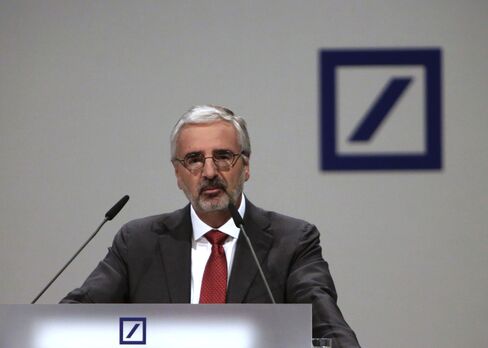
Paul Achleitner
Photographer: Martin Leissl/Bloomberg
PAUL ACHLEITNER. The chairman of Deutsche Bank’s supervisory board is known for his deep contacts across the industry. He chose Cryan to pick up the pieces after previous leaders failed to root out the misconduct that had drawn the wrath of prosecutors from New York to London. But Achleitner’s star has begun to fade as investors grow impatient with a plunging share price and continuing turmoil. The chinks became visible in April, when he became embroiled in a boardroom feud over probes into alleged wrongdoing.
ANGELA MERKEL. The German chancellor would make the final decision on any state aid for Deutsche Bank. Having steered Germany through the 2008-2009 financial crisis, she’s a veteran of bank rescues. That experience has also given her an acute awareness of the political pitfalls of assisting the financial sector, especially as Germany prepares for national elections next year. Cautious by nature, this week she said she hopes the bank “can develop well.”

Wolfgang Schaeuble
Photographer: Krisztian Bocsi/Bloomberg
WOLFGANG SCHAEUBLE. The German finance minister, the country’s elder statesman and Merkel’s chief lieutenant on financial matters, would craft and execute any government rescue of Deutsche Bank. In February he said he has “no concerns about Deutsche Bank.” These days, he’s avoiding public comment -- though on Wednesday his ministry denied a report in Die Zeit that the government was working on a rescue plan.
MARIO DRAGHI. The European Central Bank president would likely become involved before a lender is liquidated or broken up. While decisions of the ECB’s supervisory arm are usually rubber-stamped by the Governing Council, in this case policy makers may want to weigh the gravity of a bank’s woes against the potentially crippling effects that dissolving a lender would have on the euro and Europe’s economic recovery. Draghi has said he doesn’t “share the view” that low interest rates -- the root of many of Deutsche Bank’s problems -- pose systemic risk.
DANIELE NOUY. The chair of the European Central Bank’s Supervisory Board is in charge of scrutinizing Deutsche Bank’s activities and balance sheet. She will have the final say in setting the bank’s capital requirements for 2017, and would make the initial call on whether a struggling bank is no longer viable. She has suggested that Europe’s banking sector is ripe for consolidation.

Elke Koenig
Photographer: Ralph Orlowski/Bloomberg
ELKE KOENIG. The chairwoman of the Single Resolution Board in Brussels would manage any eventual liquidation or breakup of Deutsche Bank. Koenig is the first chief of the agency, established in December 2014 as a clearinghouse for plans to mitigate the negative impact of any major bank failure. As the former chief of Germany’s banking supervisor, she’s well acquainted with Deutsche Bank’s difficulties.
FELIX HUFELD. The president of BaFin, Germany’s financial markets watchdog, works with his Bundesbank and ECB colleagues to monitor banks. While Germany’s representatives on the ECB’s Supervisory Board include Bafin and the Bundesbank, only Hufeld has voting rights. He hasn’t commented on Deutsche Bank specifically, but Hufeld has said low interest rates are devastating bank profits and that institutions must cut costs to survive. “Things can’t continue as they have,” he said at a conference in Berlin on Wednesday.
MARGRETHE VESTAGER. The former Danish finance minister is now in charge of competition and state aid for the European Union’s executive arm. She would need to scrutinize any government rescue plan to check that it doesn’t fall afoul of the EU’s strict limits on giving companies public support.
Cryan Says Deutsche Bank Is Strong, ‘No Basis’ for SpeculationDeutsche Bank Troubles Sour Quarter’s End for European EquitiesFines, Withdrawals, Job Cuts. It Was an Ugly Day for Global BanksRepublicans Slam Clinton for Deutsche Speeches as Firm Slumps
Fines, Withdrawals, Job Cuts. It Was an Ugly Day for Global Banks
September 30, 2016 — 5:50 AM HKT
What Do Deutsche Bank Clients, Investors Fear?
Funds pull cash from Deutsche Bank, Commerzbank to slash jobs
Wells Fargo’s Stumpf grilled by House committee over accounts
Even before the opening bell in New York, Thursday looked like a grim day for some of the giants of global banking.
But few expected the barrage of bad news that soon hit on both sides of the Atlantic -- a rat-a-tat-tat of job cuts, scandal and financial worry that sent bank shares tumbling and left many investors wondering just where or when the pain would end.
It began in Germany, where long-struggling Commerzbank AG unveiled yet another plan to regain its footing, this time by cutting one in five of its employees. In Washington, came still more blistering attacks on John Stumpf, whose grip atop embattled Wells Fargo & Co., the largest U.S. mortgage lender, remains tenuous amid the uproar over a scandal involving unauthorized accounts.
And then, back in Germany, came the bombshell: revelations that some hedge funds were moving to reduce their financial exposure to Deutsche Bank, now the biggest worry in global finance. Before Stumpf left the U.S. House chambers after more than four hours of grilling, news broke his bank would be hit with more penalties after improperly repossessing cars owned by U.S. soldiers.
“While each has unique challenges, the overwhelming thing that has happened to the banks is they’re forgetting their purpose, while complexity is increasing opportunity for errors,” said Jon Lukomnik, executive director of the Investor Responsibility Research Center Institute in New York.
Eight years after the financial crisis, the global banking industry is groping for a way forward. Global regulators have sought to make banks look more like boring utilities, but that road has proven steep. Emboldened by an international populist groundswell, they continue to dole out fines and penalties, and firms are scrambling for ways to make money as trading volumes decline and capital requirements become more stringent.
The 38-company Bloomberg Europe Banks and Financial Services Index has tumbled 24 percent this year, while the KBW Bank Index of 24 U.S. lenders has slid 4.6 percent, led by Wells Fargo’s 18 percent decline.
In the past 10 days, Stumpf has agreed to forgo $41 million in compensation, and an adviser to Turkish President Recep Tayyip Erdogan glibly suggested on Twitter that Turkey buy Deutsche Bank as its market value fell by more than half this year. The German lender is now barely worth more than the $14 billion settlement the U.S. Department of Justice would like to extract in a long-running investigation of the bank’s mortgage securities business.
Commerzbank Chief Executive Officer Martin Zielke announced plans Thursday to eliminate 9,600 jobs, leaving it no bigger than it was before its 2008 acquisition of Dresdner Bank. The Frankfurt-based bank has lost about 39 percent of its market value this year.
“Germany is still overbanked, and it’s tough to have Germany as your home base when you want to compete with French, Spanish or American peers that operate in less fragmented home markets,” said Klaus Fleischer, a professor of finance at the University of Applied Sciences in Munich.
Wells Fargo agreed to pay more than $24 million to the Justice Department and the Office of the Comptroller of the Currency to settle allegations that it improperly repossessed cars owned by members of the military.
“I don’t personally see how you survive,” Representative Denny Heck, a Washington Democrat, told Stumpf Thursday as the 63-year-old CEO testified before the House Financial Services Committee.
Lawmakers called for Stumpf to be fired, for Wells Fargo’s board to be replaced and for the bank to be broken up.
“Your problem is coming,” Representative Mike Capuano, a Massachusetts Democrat, told Stumpf at the hearings. “You think today is tough? It’s coming. When the prosecutors get ahold of you, you’re going to have a lot of fun."
As the hearing was under way, news broke that some of Deutsche Bank’s clients were said to be reducing their collateral on trades, sending its New York-listed shares down as much as 9.1 percent. Earlier this week, CEO John Cryan was forced to shoot down speculation the bank needs more capital and may require a bailout, as its shares touch record lows and a U.S. litigation settlement looms.
“Our trading clients are amongst the world’s most sophisticated investors,” Michael Golden, a spokesman for Deutsche Bank, said in an e-mailed statement. “We are confident that the vast majority of them have a full understanding of our stable financial position, the current macroeconomic environment, the litigation process in the U.S. and the progress we are making with our strategy.”